⋙ “Talking about the things you’re passionate about” is a phrase that’s treated as obligatorily positive, when in truth you can be fond of something while simultaneously recognizing your disdain for it. On its most immediate level, one could say that pelambre—talking shit about others—exists in this same space, even though it obviously doesn’t carry the same value or moral weight. I’m starting this way because I think I’ve already buttered you up a bit with things I genuinely appreciate.
That said, I think I can honestly consider myself a no-filter fan of Resident Evil, especially of the classic formula. But instead of writing about my favorite entries, or going in chronological order, I decided to cut things off at the—well—“healthy” point. To immediately define my limits.
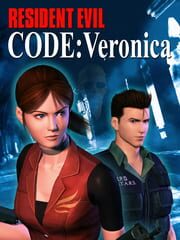
I hate Resident Evil: Code Veronica with a passion, in all its versions.
⋙ So we’ll do things differently. I’ll give you a carefully worked list of good things first.
✚ The opening of this game is fantastic, and I genuinely believe that on a conceptual and purely visual level, the spaces it inhabits are generally well executed—lugubrious, cold, and even beautiful from a Y2K perspective. Little by little I’ve let go of the friction I used to have against pre-rendered graphics in a classic RE.
✚ Along the same lines, I’ve really warmed up to its mid-2000s anime-style designs, somewhere between The Sims 2 and a French/Canadian TV series. Claire best girl.
✚ Fully introducing the zombie in small but dangerous quantities is also a great call; beyond their depressingly dead design, in this title the undead are particularly annoying, and making the player understand that quickly is a smart move.
✚ Where I really give Code: Veronica some love is in the visual, mechanical, and narrative connection it establishes to cement Umbrella as a dynasty with sacred airs—something RE Survivor had already worked on and RE:0 would later develop a bit further. The Ashfords, Alexia and Alfred, the entire game it plays with genetic obsession, inheritance, and iconoclasm, all reflected in the gothic spaces it presents. Victorian imagery, castles, dolls, carousels—signaling a loss of innocence in the face of domestic horror.
✚ I genuinely appreciate sex appeal when it’s this honest, and we should never forget—something I did for a long time—that Resident Evil has always been anime bullshit. Alexia as hypersexualized body horror—monstrous, horny, oppressive—is a direct connection to the problematic themes Code Veronica touches on: the price of incest. Even if it stumbles into some degenerative and offensive gender commentary along the way.
And…
…That’s it.
Now the rest.
✘ Code Veronica is sloooooooooow. Like, unbelievably slow to really open up—not just the expected and necessary backtracking of a full-blooded survival horror. Oh no, it genuinely wants to waste your time. Before that, you have to run laps around the same area over and over, only for it to later open into three different locations you must juggle in terms of route and inventory—an absolute exaggeration of the values people appreciate in earlier and later entries. Yes, yes, you can have too much of a good thing, and this is a poster-child case. This also means it’s a long game, so…
✘ The infamous instances of soft-locking, unavoidable deaths, or situations that require extreme precision and inventory dumping stand out even more. As if it weren’t enough that the game is demanding with what it gives you, it pulls these cracked knowledge-and-skill checkmates—and to top it all off, it does so after grueling minutes of constant play. That Chris “switcheroo” is… it’s diabolical.
✘ Code Veronica has a sort of rock-paper-scissors combat system. Bandersnatches—one of the worst enemies I’ve had the sadness of meeting in my life—are weaker to explosive bolts, others seem to have other weaknesses, etc. Which is, again, a constant test of premeditation that doesn’t come close to this level in any other title, except maybe RE Gaiden. This is made worse by enemy respawning.
✘ While the knife is the most effective it’s ever been in the franchise, the enemy roster is more unpredictable than before—even in speedruns I’ve watched, Bandersnatches are the enemy that determines run time, and every attempt I see contradicts the previous one. Sometimes the grab doesn’t connect, sometimes you kill it in ten knife hits, sometimes it tags you, drops you into red health, and takes twenty knife hits. A fucking mess.
✘ Playing on Easy Mode (exclusive to specific Japanese versions, God knows why) didn’t make it any better: the onion-layer progression design became even more obvious, ammo scarcity turned into inventory-space scarcity for literally everything else, enemies die ridiculously fast so you end up shooting into the air just to waste bullets and manage your slots properly… It becomes a competition against your own patience, moving items between boxes and metal detectors.
✘ After FOUR ATTEMPTS at replaying it in an optimized way after my first run, it’s only natural that I ended up hating it.
✘ The Chris–Wesker relationship is where things really kick into high gear here. And well… that’s that. It’s never been something that motivates me much about Resident Evil, so I guess it exists.
✘ As if it weren’t enough that Steve is by far the worst character in the game, it’s established from the get-go that he’ll be Claire Redfield’s romantic interest… to this day, I suppose. What a way to reduce Claire to a piece of meat. Blergh.
✘ Alexander Ashford remains part of the “latent danger” representation of sexual dissidence established by films like The Silence of the Lambs, which I can’t ignore.
✘ Did I mention that I hate Bandersnatches?
Fucking awful game. It’s so interesting.
In a way, it’s the obvious de-evolution of the franchise at that moment—choosing to bend the player over backward in opposition to the simplicity of its predecessors, something done deliberately and without mercy—and that, at least, is worthy of respect.
CYAN
AESTHETICS ⭕ // INTEGRITY ⭕⭕⭕ // DENSITY ⭕⭕⭕